Promising evidence across studies
A systematic review found that learning words through song benefited at least one memory measure in 28 of 37 studies. Results varied across tasks and learners.
Derks-Dijkman et al. · Neuropsychology Review, 2024Learn biology, chemistry, calculus, and physics with songs, synced explanations, and quick quizzes.
Listen to our sample songs
Sample tracks from our growing STEM catalog.
Explore the library and what’s coming.
Still remember the alphabet song? You learned it as a child, and the melody is probably still with you.
Now imagine giving the Krebs cycle, integration rules, or Big O complexity a melody of their own.
See the ScienceStart with a song, explore the ideas behind the lyrics, and check what you remember with quick quizzes.
Press play on the bus, walking to class, or lying in bed.
Meet the key ideas in a song, so you have something familiar to build on when you study.
Explore the ideas behind the lyrics.
As the song plays, a companion panel follows along—diagrams, key concepts, and notes for the line you're hearing.
Nothing interrupts the music. Catchy lyrics become active lessons.
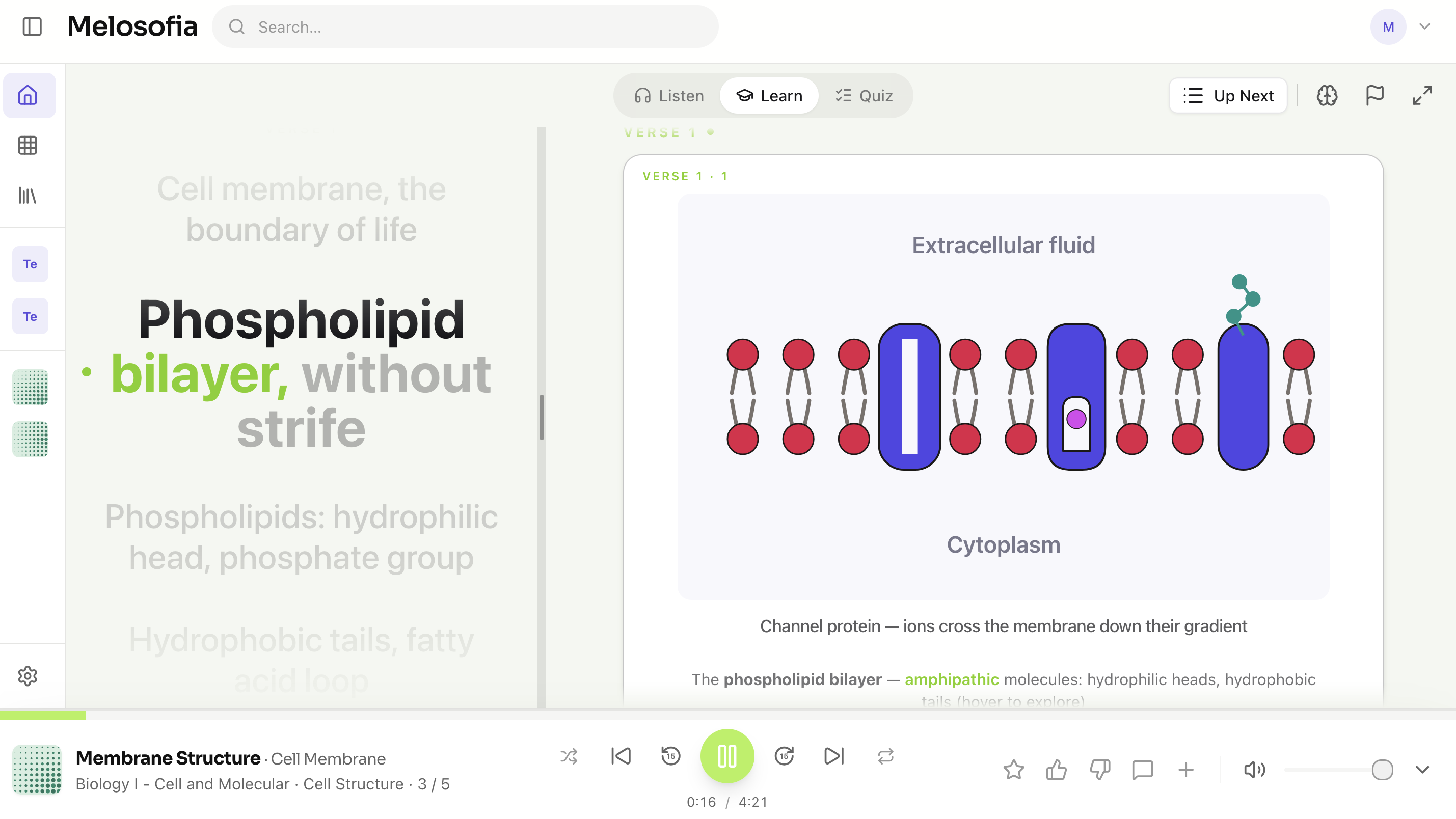
Come back to the songs over time, making familiar ideas part of your daily rotation.
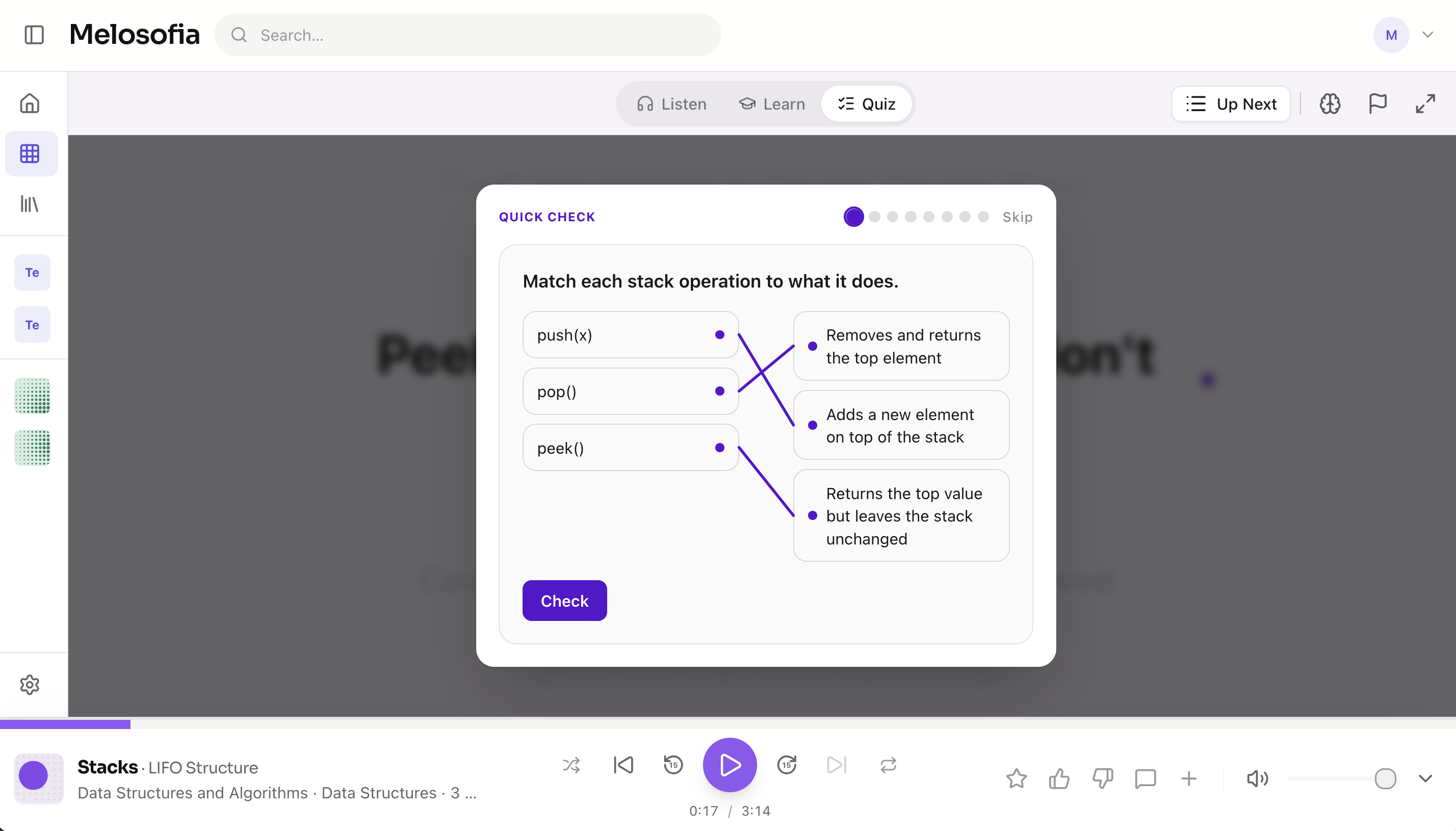
When you're ready, switch to Quiz: the song pauses for a quick check, then picks right back up.
Find out what you remember—and what needs another listen.
Putting ideas to melody can give you another way to recall them. Here’s what research on musical learning has found.
A systematic review found that learning words through song benefited at least one memory measure in 28 of 37 studies. Results varied across tasks and learners.
Derks-Dijkman et al. · Neuropsychology Review, 2024In a study of 62 students, a group taught Krebs-cycle songs alongside diagram activities scored higher on an immediate recall test than a group studying notes. The study combined music with teacher-led instruction and did not test longer-term retention.
Yeoh · Learning Science and Mathematics, 2016In a 36-person study, learners using KoroT-3E to create personalized songs about computing concepts scored higher on one-week tests than those studying text. This small preprint studied song creation and personalization alongside listening.
Yuan et al. · arXiv preprint, 2024These studies inform our approach. They did not test Melosofia or establish its effect on course grades.
Explore four foundational STEM courses. Plenty more on the way.
Life Sciences
Chemistry
More playlists coming soon
Mathematics
Physical Sciences
More playlists coming soon
More songs and playlists are on the way, with Linear Algebra and Statistics also in development.
Founded by an MIT '19 Math & CS graduate who knows firsthand the demands of challenging technical courses, Melosofia combines beautiful music, memory science, and intelligent learning systems to help students master difficult concepts faster and more confidently.
Choose the plan that fits your semester
Ideal for: A full semester of learning
Get Semester PassIdeal for: Finals cramming or short-term review
Start MonthlyLearn through music in Biology, Chemistry, Calculus, and Physics.